

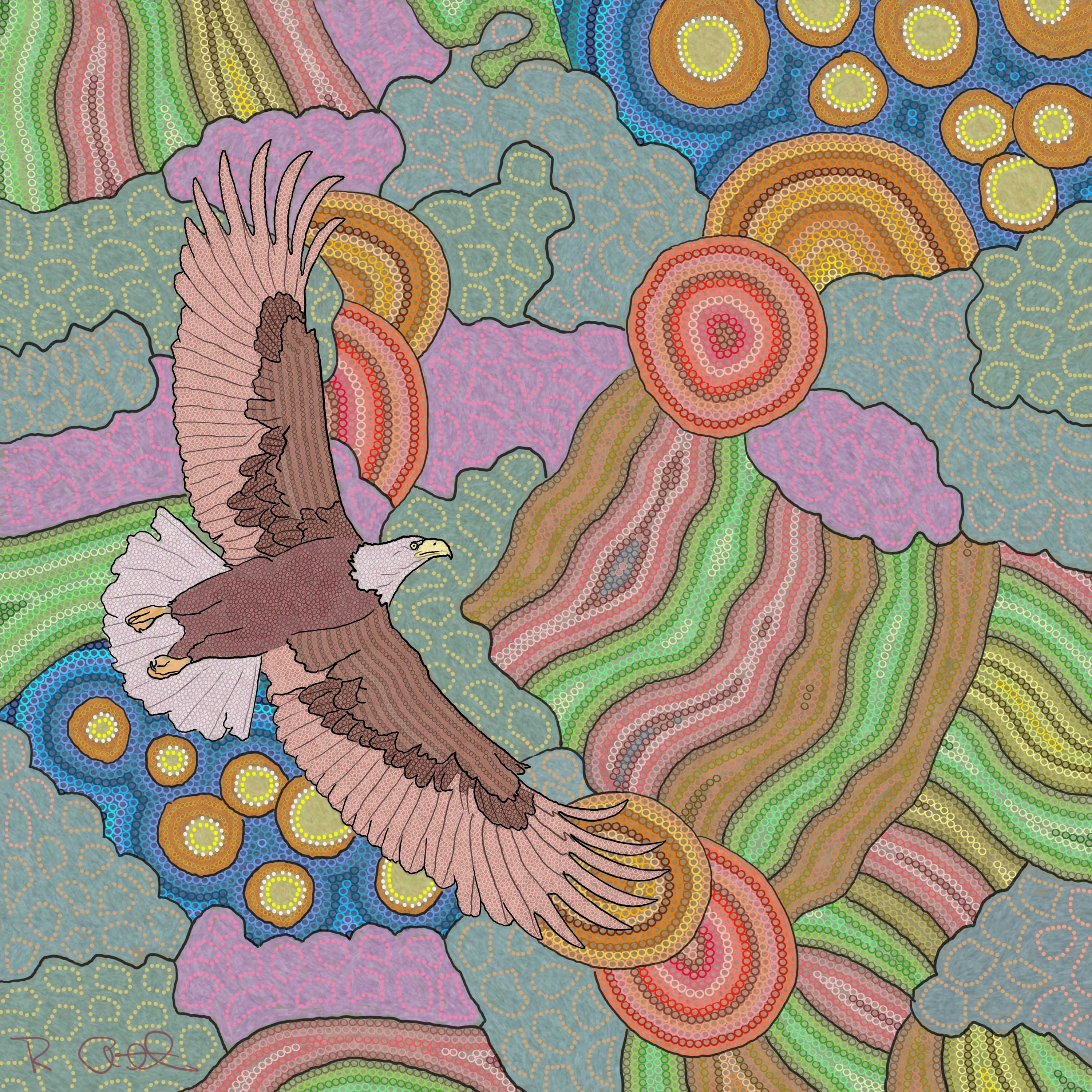
“Sovereign” from Winged Sun series by Robert Althouse
We are living through a politically fraught season, thick with uncertainty about the future. Power feels like it is being decided somewhere far above our heads, in capitals, in boardrooms, in the server farms of companies building an artificial intelligence none of us voted for. It is easy to feel like a subject in someone else’s kingdom. So perhaps it is time to reclaim our agency by proclaiming our own sovereignty, a sovereignty freed from political control, from rich technocrats, from the dream of AI as an alien intelligence come to rule us.
I want to be careful with that word, because sovereignty is having a strange moment. All around us it is being claimed in a defensive way: the sovereign citizen who opts out, the sovereign individual who withdraws behind walls of money or code, the fantasy of escaping into a bunker where no one can touch you. That is not what I mean. That kind of sovereignty is just another form of fear. It builds a fortress and calls it freedom.
The sovereignty I speak of here is the opposite of a fortress. It cannot be walled off because it was never separate to begin with. It is not power over anything. It is the natural dignity of a human being who has come home to themselves.
The Wheel-turner
In the Shambhala teachings, Chögyam Trungpa spoke of the universal monarch. I have always had some trouble with this teaching, because it felt too political to me, too much like kings and thrones. And perhaps it is, but maybe it is also possible to hear it in a spiritual way: as the declaration of our true nature in the world, the lion’s roar that proclaims the basic sanity of the dharma.
“Universal monarch” is Trungpa’s translation of the Sanskrit chakravartin, which literally means “wheel-turner.” It points to an ancient ideal of a ruler whose reign extends everywhere, not through conquest or force, but through the sheer authenticity of their presence. The wheel-turner does not seize the world. They set something in motion, and the world orders itself around it.
I find it worth pausing on that image of the wheel, because there are two wheels in Buddhism and they turn in opposite directions. There is the wheel of samsara, on which beings are turned round and round by their karma, by craving and fear, never quite in the driver’s seat of their own lives. And there is the wheel of dharma, which the awakened one sets turning. To be sovereign is to stop being turned and to become the one who turns. It is the difference between being spun by the current and being the still point at the center.
We know this wheel intimately now, even if we don’t call it that. The feed is a wheel. The news cycle is a wheel. The outrage of the morning that is forgotten by evening is a wheel. We are turned by it all day long, and we call that being informed. Sovereignty is not the refusal to know what is happening in the world. It is the refusal to be spun by it, the capacity to stand at the hub while the rim goes round.
The Shadow of the Throne
I cannot write honestly about this teaching without sitting with the shadow it carries in the Shambhala lineage. Trungpa did not leave the universal monarch as an abstraction. He gave it a body and a name. He conferred on his eldest son the title Sakyong, Tibetan for “earth protector,” and made him his heir and the head of the community he had founded. His son became the living Sakyong, enthroned as the sovereign of Shambhala.
I want to be careful here, because I owe these teachings a great deal. Trungpa brought something luminous to the West. The vocabulary I am using in this essay came through him and through the community his son led: windhorse, the four dignities, heaven and earth, and the spiritual warrior who joins them together. Many people, myself among them, found something true and life-giving there. I do not want to flatten that, and I do not think honesty requires me to.
But honesty does require me to say the rest. In 2018 a number of women came forward with accounts of sexual misconduct on the Sakyong’s part, much of it bound up with drinking. He acknowledged that he had caused harm and stepped back from teaching. Nor was he the first. His father’s own drinking was no secret, and it wore him down long before his time. Two generations, two anointed “monarchs”, and in both the same appetite and misuse of the very power the teaching says must never be grasped.
I don’t think I am supposed to resolve this neatly, and I won’t pretend to. Some days it darkens the teaching for me. Other days I feel the teaching and the teacher were never the same thing. I hold both, and I have stopped needing to choose between them.
What I have come to, at least for now, is this. Their falling does not empty the teaching of meaning. If anything, it shows me, painfully, where sovereignty does not live. What pulled these men under was exactly what sovereignty is meant to be free of: the hunger of ego, power taken as territory and turned toward the people closest to them. The eagle in my painting is honored precisely because he could strike and does not. That restraint is the whole of it and it is the one thing that failed here. A title that means “earth protector,” carried by a man who could not protect the women in his care, is a hard and honest reminder that no name and no throne confers the thing itself.
And maybe that is the quiet gift hidden in our disappointment. Sovereignty does not live on a throne, or in a bloodline, or in any single anointed person. That is why it needs to be brought down from on high back to each of us. The painting takes sovereignty back from the flag. No enthronement can grant it and no lineage can guarantee it. It is confirmed by each of us day by day in our own practice.
None of Us Are Innocent
It would be easy to read all of this as a verdict passed on other men, and leave feeling justified in some way. But that is the one response to this story I cannot bear. The honest thing is harder: to recognize that the appetite that pulled these teachers under is not foreign to me. It lives in me too.
Buddhism has an image for it, the hungry ghost: the being with a swollen belly and a throat as thin as a needle, forever starving, never able to take in enough nourishment to be fulfilled. We like to picture the hungry ghost as someone else, the addict, the tyrant, the fallen guru. But the hungry ghost is not a person. It is a weather that moves through all of us, the part that always wants more, more approval, more security, more of whatever we are sure will finally make us whole. None of us are innocent.
So how do we hold this? How do we stay upright, keep faith with our own integrity, and at the same time admit that we are each capable of becoming a hungry ghost? I don’t think the answer is to lower the bar, and I don’t think it is to pretend the hunger isn’t there. Integrity is not innocence. It is not the absence of the hungry ghost but an honest, ongoing relationship with it: knowing it is there, feeling it move, and choosing again and again not to be ruled by it. It is the same restraint we honor in the eagle, who is not a creature without talons but one who has them and does not strike indiscriminately.
To be at peace with our own imperfection, is not moral laziness. It is the ground of any real morality, because a virtue that has never met its own shadow is brittle, untested, and untrustworthy. We will make mistakes. We will fall short of the very things we write essays about. Wholeness, as Jung insisted, has room even for this. The sovereign self is not the one who never hungers. It is the one who can hold the tension, upright and imperfect, and keep walking.
Joining Heaven and Earth
The wheel-turner is what the spiritual warrior becomes when they join heaven and earth. This is another Shambhala teaching Trungpa developed from Asian cosmology. The same structure underlies Japanese flower arranging, where the three lines are called heaven, earth, and human.
Heaven is the principle of vision, vastness, and space. It’s the large perspective of inspiration, creativity, and unconditional openness, the primordial ground of possibility.
Earth is the principle of ground, practicality, and receptivity. It’s the concrete situation that supports and receives, where vision has to actually land and take form. Without earth, heaven is a mere abstraction.
Human is the principle that joins the two. The human stands between heaven and earth and connects them, bringing vision down to practicality, lifting up practicality toward vision. The human joins and integrates heaven and earth. When they are joined harmony emerges, what in Shambhala is called the Great Eastern Sun.
We also have this same teaching in the precepts we take in Zen Buddhism. When we take refuge in the three treasures of Buddha, Dharma, and Sangha, our understanding is that when the Buddha (Heaven) and Dharma (Earth) are in accord, then Sangha emerges, which in this context means “harmony.”
The marriage of heaven and earth is done by each of us joining the two in our own lives, and this is an expression of the wholeness of life where nothing is missing. This wholeness is sovereign in itself. It needs no external confirmation, no approval, no vote of the people. It is already here.
Being Alone with Yourself
Each of us can discover this sovereignty simply by being with ourselves, through the practice of meditation. One definition of a spiritual warrior is a person who is not afraid to be alone with themselves. So maybe meditation is not even the right word. Maybe a better word is attunement, or “getting accustomed to” oneself. In this way you become intimate with yourself and others. This is the doorway to freedom and sovereignty.
This is harder than it sounds, and harder now than it has ever been, because we have built a civilization designed to make sure we are never alone with ourselves for even a moment. There is always a screen, always a notification, always something beeping at us, always something to be turned by. To sit down and be with yourself, unentertained, undistracted, is a genuinely radical act. It is where sovereignty is actually won, not in any declaration, but in the simple willingness to be your own best company.
Setting the Wheel in Motion
The universal monarch rules by setting things in motion, not by conquering territory. I was reminded of this at our Zen Center recently. For our Day of Remembrance to honor our ancestors, June Roshi led our community in several traditional Japanese Bon dances. June Roshi told us that the Japanese feel that when they dance for their ancestors, they are freeing them from negative karma, releasing that karma through movement. I find that to be a beautiful teaching: grief and inheritance and everything unresolved in a family line, loosened not through force but through the simple act of turning bodies in a circle. That is the chakravartin’s gesture: setting the wheel of dharma in motion. Not fixing, not conquering. Moving, and letting movement do its work.
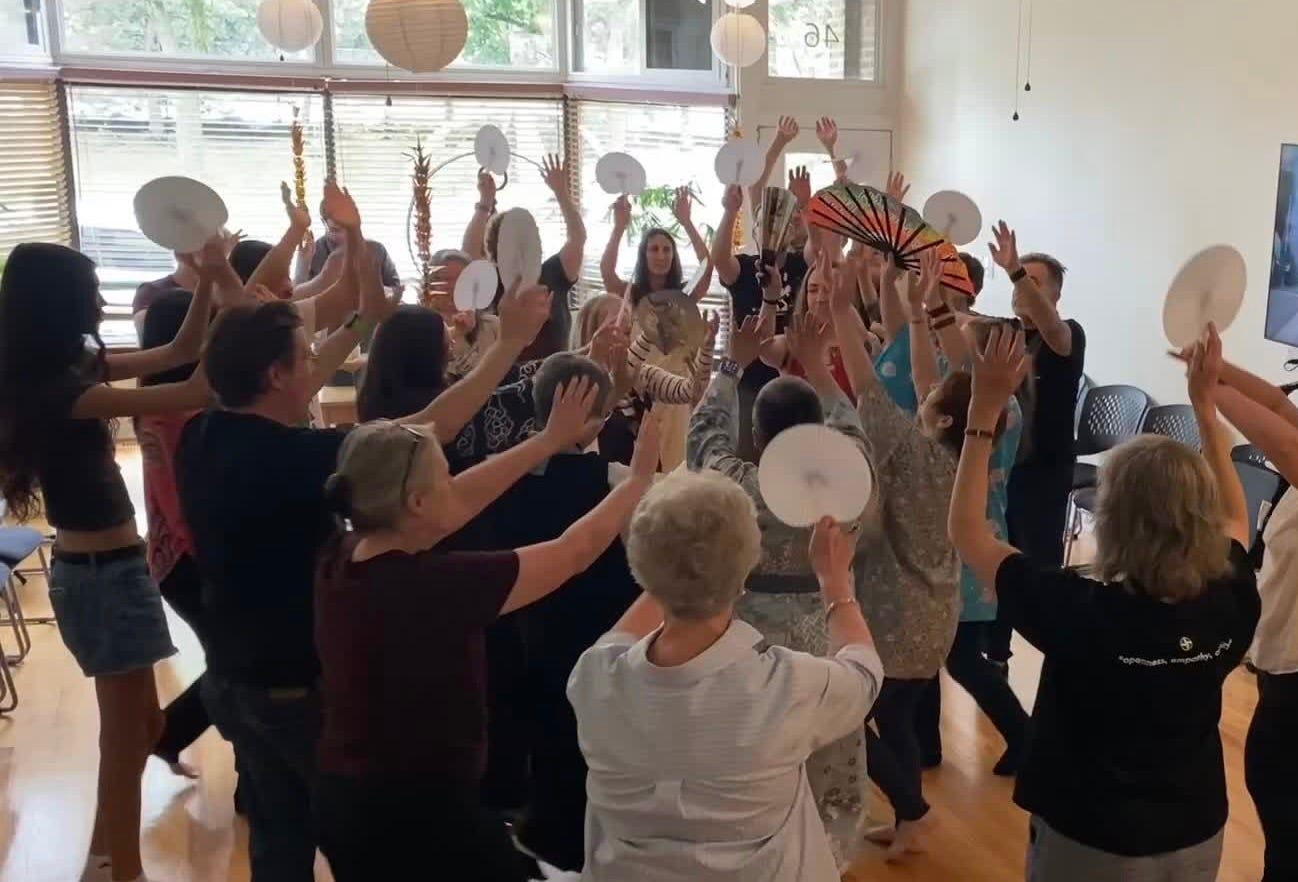
Obon dancing at Zen Life & Meditation Center
We are sovereign, then, not through aggression or possessing territory, but through open-heartedness, kindness, and courage.
The Restraint of the Eagle
Which brings me to the eagle.
The spiritual warrior becomes sovereign when windhorse is fully raised, when they carry themselves with confidence that needs no territory and no ego to prop it up. Windhorse, lungta, is the energy of basic goodness ridden with dignity rather than aggression. The four dignities I have written about elsewhere on this substack (the meek, the perky, the outrageous, and the inscrutable) all culminate in this state: the one who rules the world without conquering any part of it.
The bald eagle is, of course, the great symbol of America, of freedom and power in the conventional, muscular sense. My painting of the eagle takes that word sovereignty back. It relocates state power away from the state and returns it to the natural dignity of each of us, as individual human beings, regardless of age or political persuasion. The eagle in the painting does not belong to a flag. It belongs to the sky, the land, and the wholeness in each of us that the sky and earth have always stood for.
But there is a deeper reason the eagle is the right bird for this, and it comes not from the national myth but from the people who watched these birds long before there was a nation. Many Native peoples respected the eagle precisely because he was restrained in the use of his power. In their book, Birds Through Indigenous Eyes: Native Perspectives on Birds of the Eastern Woodlands by Dennis Gaffin with collaboration of Michael Bastine & John Volpe, he says: “Why do Natives look to eagles and hawks and hold them in such high esteem? It is not because they have great vision or sharp talons or a beak that can tear flesh. It is because of the eagles’ interactions with crows and red-tailed hawks–how the eagle and other birds of prey restrain themselves from hurting crows and others that are bothering them. Often in the sky you can see smaller birds, like crows or starlings, attacking eagles and hawks. The eagles and hawks do not react and do not retaliate with the crow, or starlings, or other birds that bother them. If they so desired eagles could easily, even in midair, use their strong talons to injure or kill the birds that bother them.”
I can think of no better image for sovereignty as I mean it. The tyrant strikes because he can. The sovereign one refrains because he can. Real power is not measured by what you are able to destroy; it is revealed by what you choose not to. The eagle who could kill the small bird lets it live and sets the wheel turning instead.
Acting Skillfully in the World
I want to be careful that none of this is mistaken for withdrawal from the world. Sovereignty as I mean it is not quietism. It is not retreating to the cushion or the mountaintop and letting the world burn. If it were, it would be just another version of the bunker which is another prison we build around ourselves to try and keep the world out.
The whole point of joining heaven and earth is that vision has to land. Heaven without earth is a daydream. The warrior brings inspiration down into the concrete situations and acts. In Zen, in the last of the ox-herding pictures, the bodhisattva is seen coming back into the world, entering the marketplace with gift-bestowing hands.
What sovereignty changes is not whether we act but how. The person spun by the wheel acts too, constantly, but their action is reactive: driven by fear, by anger, by the hunger for approval, by whatever the feed put in front of them that morning.
Restraint and action are not opposites. They are the same discernment seen from two sides. The eagle who declines to strike the crow is the same eagle who dives without hesitation when it is time to act.
The sovereign warrior enters the fraught season with kindness and courage, and does what they can without being consumed or taken down by the suffering they encounter. They have no fixed idea of what needs to be done, only a willingness to not know, to witness what is in front of them, and to respond.
Sovereignty isn’t opting out. It’s the ground that allows you to respond skillfully to difficult situations. The spiritual warrior comes back into the world to vote, to advocate for change that reflects his or her core values, to build, to protest, to care for the sick and the poor, to speak truth to power from a center the turning world cannot spin.
Jung’s Four Teachings
The true nature we speak of in Zen is this authentic self, freed from the self-conceit of ego, and here Jung keeps pace with the dharma. As I understand him, he leaves us four teachings that describe the whole psychological and spiritual arc of a life spent turning the wheel of dharma from birth to death.
The first is individuation, the lifelong work of becoming undivided. For Jung the individuated self is the sovereign self, the one able to hold the tension of opposites in awareness, to entertain ambiguity and paradox without collapsing into one side or the other. This is the joining of heaven and earth. It’s the middle way in Buddhism. The sovereign person is not the one who has resolved every contradiction, but the one who can hold them together.
The second is that wholeness requires the integration of the dark, not transcending it, not bypassing it, but taking it in. Spiritual practice is not a cleansing that leaves only the light; it is the breaking open of the ego into a larger reality that has room for everything, including the shadow. This is the harder loyalty a lineage asks of us: not to look away from the darkness in our teachers, but to take it in with open eyes and refuse to let it have the last word. A teaching survives its teachers only when we can hold both, what they gave us, and how they failed it. This wholeness is what in Zen we call your true nature. It has never been broken, bent, or betrayed. It was whole before you began, and it includes the parts of you that you would rather not see.
The third is meaning beyond accomplishment. As we get older this one grows unavoidable. The accomplishments that felt so meaningful when we were young fall away, one by one, until there is nothing left to accomplish. Aging forces us to look at our lives through a different lens. In Zen there is a teaching for this called the true person of no rank, no title, no role, no rėsumé, no brand. Aging is a long emptying out and what the emptying reveals is that the sovereign self was never made of accomplishments in the first place. When the territory is finally gone, the confidence that never needed this confirmation is all that remains.
The fourth is to make peace with death and aging. And this is where the whole essay comes to rest, because aging is sovereignty’s most honest teacher. Life is not diminished as we age; it is enriched by the intimacy that draws closer to things. We can age with dignity, sovereign in our own direct experience. We need no one’s approval. We can rest in silence and open our hearts.
It is Already Here
So this is what the eagle is flying home to. Not a country. Not a party. Not a fortress. The undivided self that no election can grant and no technology can take, the wholeness that has never been broken. In a season when everyone is arguing about who gets to rule, the quietest and most radical thing you can do is discover the one who rules the world without aggression, and find your own original face before your parents were born.
It is already, always here.
~ Roshi Robert Althouse © 2026
Tremendous ..robust…provocative..and so rich with loving kindness..nothing “to do” but breath. Thanks for your wonderful teaching. Gassho
When I think of the kind of sovereignty you seem to be gesturing at, I think of Old Boss—as a mythic baby—delivering that line (through all of our mouths at once) “in all of heaven and earth, I alone, the world-honored one.”
Standing “alone”, free and supremely sovereign.
In this conditioned realm, we might call it the difference between *power* and *authority*. As you say, it is the “opposite of a fortress,“ because it cannot exclude a single being. does that make any sense?
Anyhoo lol. 🤪 Great read! Always grateful that you share these thoughts! ❤️🙏