

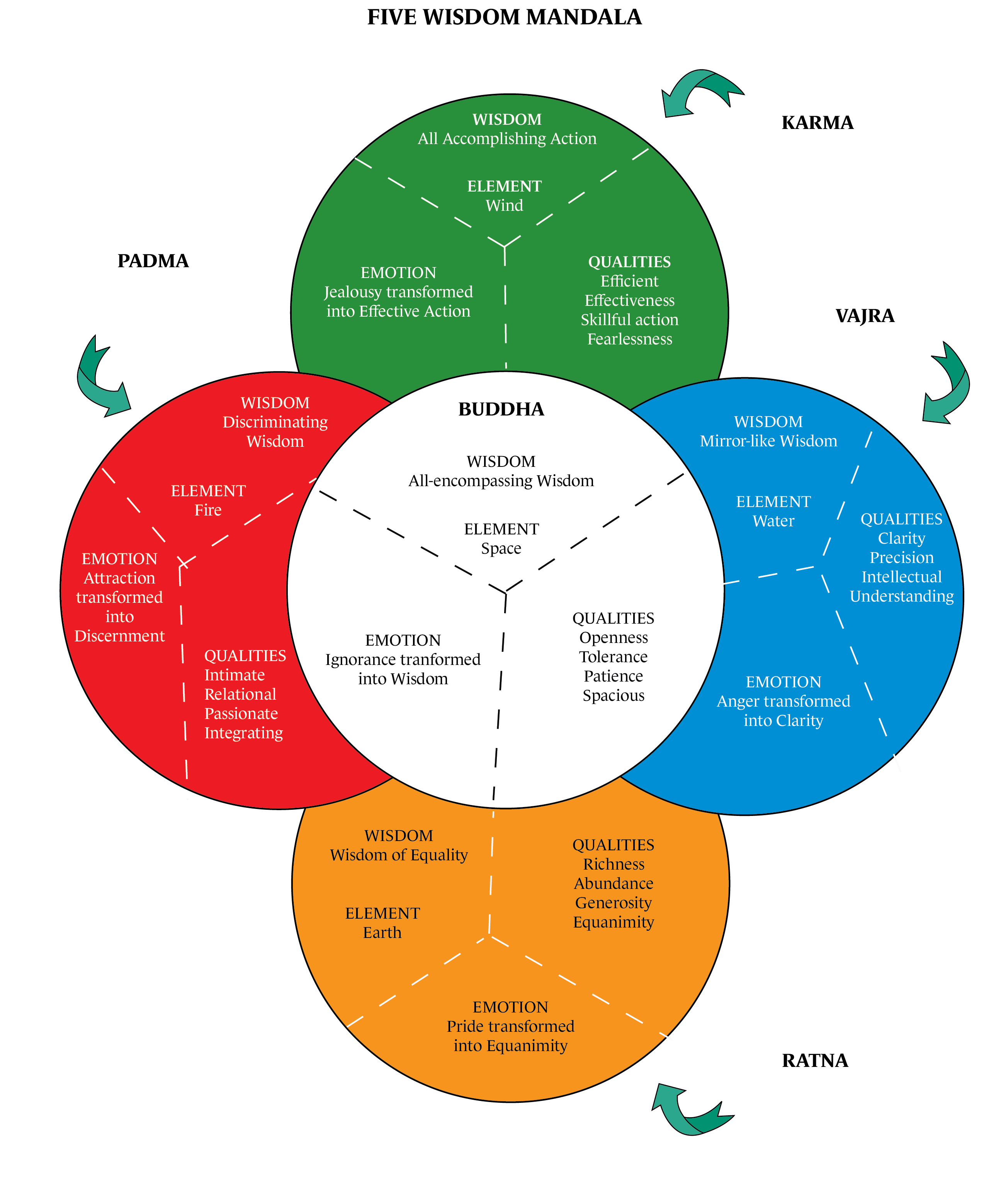
The teaching known as the Five Buddha Families (Five Wisdoms) comes from the Vajrayana tradition. I first learned it from my teacher, Chögyam Trungpa Rinpoche, many years ago, and I have been working with it for most of my life. It has been a source of artistic and spiritual inspiration for me and given me insight into my own patterns and those of others. The teaching also integrates with the Yogacara teaching of the Eight Consciousnesses. In our Gate of Sweet Nectar service, which we chant at my Zen Center, we invite these five wisdom energies into our space to help feed the suffering of hungry ghosts.
The mandala shown here is the best way I have found to present this teaching as a whole. The mandala is a consecrated space containing both confusion and clarity; chaos and order; samsara and nirvana. The word itself means “circle” or “association”. A mandala is not just a symbol, a thangka, or a sand painting. It is your life itself. You are the living mandala, and through this lens you can begin to appreciate your life as an expression of five patterns of awakened and unawakened energy. Each family contains both clarity and confusion. They are two sides of the same coin. Rather than denying the negative or pushing it away, by working with it with awareness, you can gradually transmute that negativity into the awakened quality of that particular family.
According to these teachings, enlightened energy is not monolithic. It comes in five flavors. Some are peaceful, some aggressive. All are aspects of awakened energy, but they manifest in five very different ways.
Each of us is born with one of these families as our primary orientation in life. Once you identify yours, you can work with yourself with greater insight, appreciating both how you get stuck and the inherently sane, awakened qualities you carry. As practice matures, we begin to access all five energies in the appropriate contexts of our lives. Some will come easily; others may feel difficult or even threatening. In those cases, practice invites us to patiently allow these less familiar energies to be present in our experience without pushing them away.
Once you begin to recognize these patterns of others, you can become less judgmental about behavior driven by their negative energies, and more insightful about how to help them work with their edge. Understanding your own family matters too, because we tend to project it onto others. If yours is a relatively peaceful family such as Buddha, and you encounter a Vajra person who is very aggressive, you will tend to think they should be more peaceful like you. But that is a projection. Knowing your own family helps you work more skillfully with other families very different from your own.
It is important to understand how our own confusion creates suffering. We are strategically confused. It’s not accidental. Confusion arises because of our own reaction quality of awakened energy that is always here. The spaciousness is empty because it contains no dualistic reference points.
Through wholehearted practice, duality commits suicide. Duality wants to watch itself wake up, but you can’t attend your own funeral. When you finally clarify and wake up, you want to run and tell your teacher who, will be so proud of you, but he has already died. So the whole thing has this bitter-sweet quality to it.
Each family has an outward form and an inner quality associated with it. Some abide in outer forms such as contemplation, study, work, relationships or social action. They also express inner qualities of open spacious wisdom, precise cutting clarity, rich generosity, juicy passion, and efficient skillful action.
Let us appreciate each one in turn, along with the Dhyani Buddha I have painted to go with it.
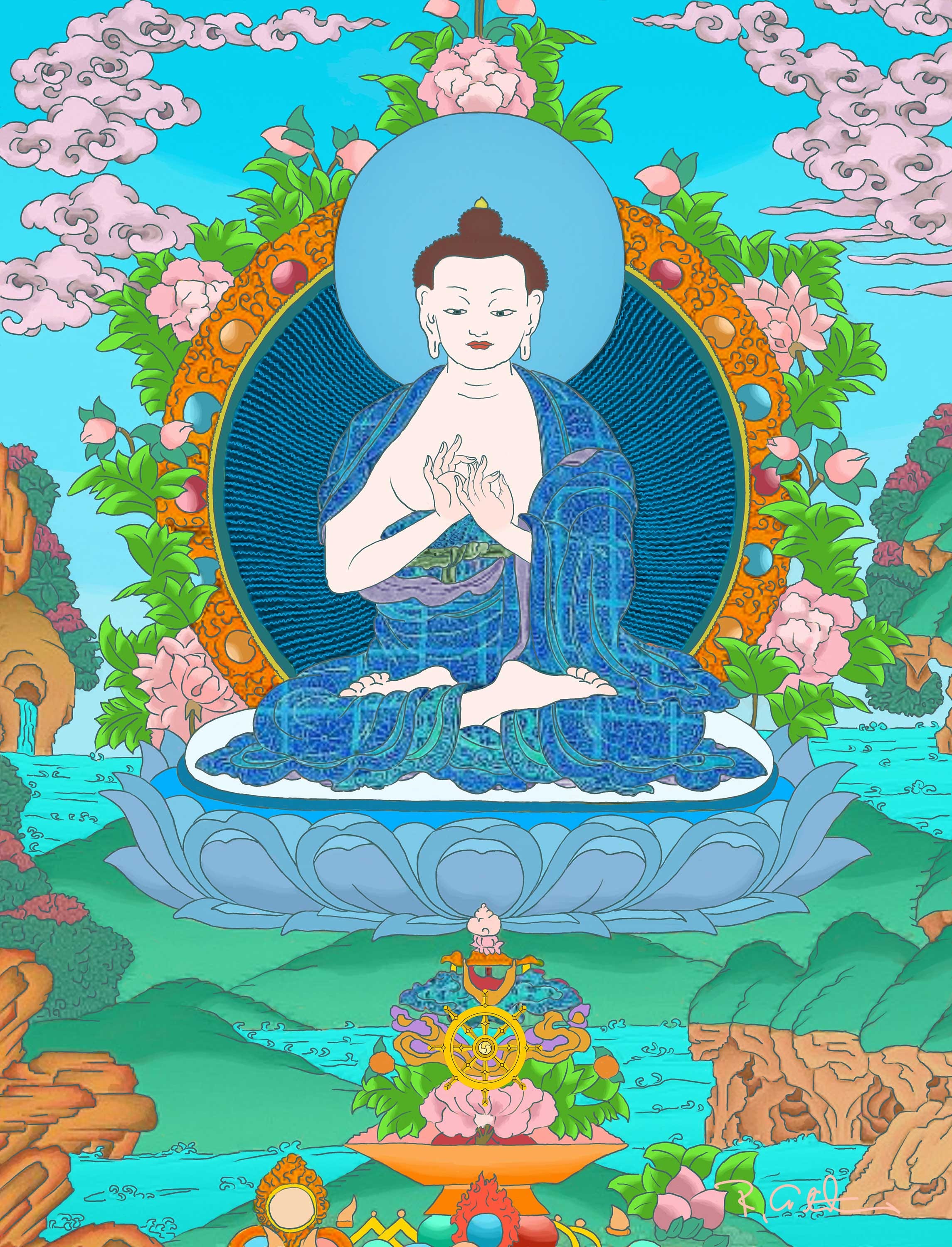
Vairochana: The Buddha Family
The Buddha Family sits at the center of the mandala. It’s quality is spacious and open, accommodating and accepting all the other family energies. It aligns with the outer forms of meditation and contemplation. Its closed pattern is ignorance, playing deaf and dumb, or being spaced out. Because it sits at the center, we can say that all the other families react to its spaciousness through their particular patterns of fear. Each negative family energy is a defensive response to the fear of this openness. The element of this family is space, and its color is white.
Vairochana, whose name means “the Illuminator” or “Resplendent One” is the Dhyani Buddha of the Buddha Family. He embodies the dharmakaya, the cosmic body of truth, and represents the all-pervading, luminous nature of awakened mind. His mudra is the dharmachakra, the gesture of turning the wheel of dharma, and his symbol is the wheel itself. Vairochana transforms the poison of ignorance into the wisdom of all-encompassing space (dharmadhatu-jnana), the awareness that perceives everything within an open, undivided field.
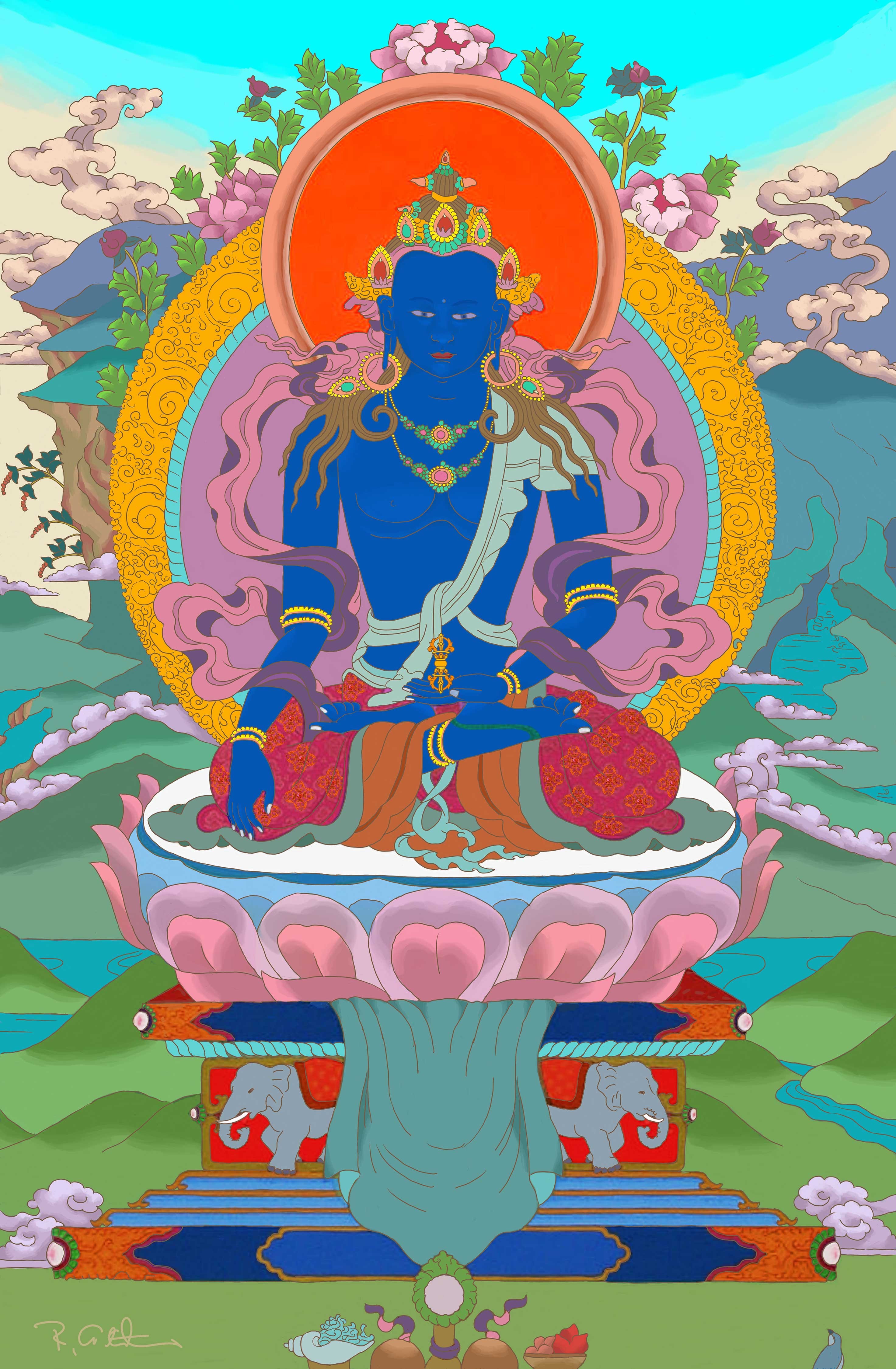
Akshobhya: The Vajra Family
The Vajra Family occupies the eastern direction of the mandala. It is characterized by sharp, precise clarity that leaves no stone unturned; aggressive and penetrating. Vajra tends to express itself in outer forms such as scholarship or translation. It experiences the spaciousness as threatening and reacts to it with anger. Its element is water, and its color is blue.
The Dhyani Buddha of this family is Akshobhya, “the Immovable One.” His origin story tells of a monk who, while still a bodhisattva, vowed never to harbor anger or aversion toward any sentient being. He held that vow unshakably through countless lifetimes finally attaining buddhahood in the eastern pure land of Abhirati. His mudra is bhumisparsha, the earth-touching gesture; the same gesture Shakyamuni made at his own awakening. His symbol is the vajra, the indestructible thunderbolt. Akshobhya transforms anger into mirror-like wisdom (adarsha-jnana): the clear, reflective awareness that sees things exactly as they are, without distortion.
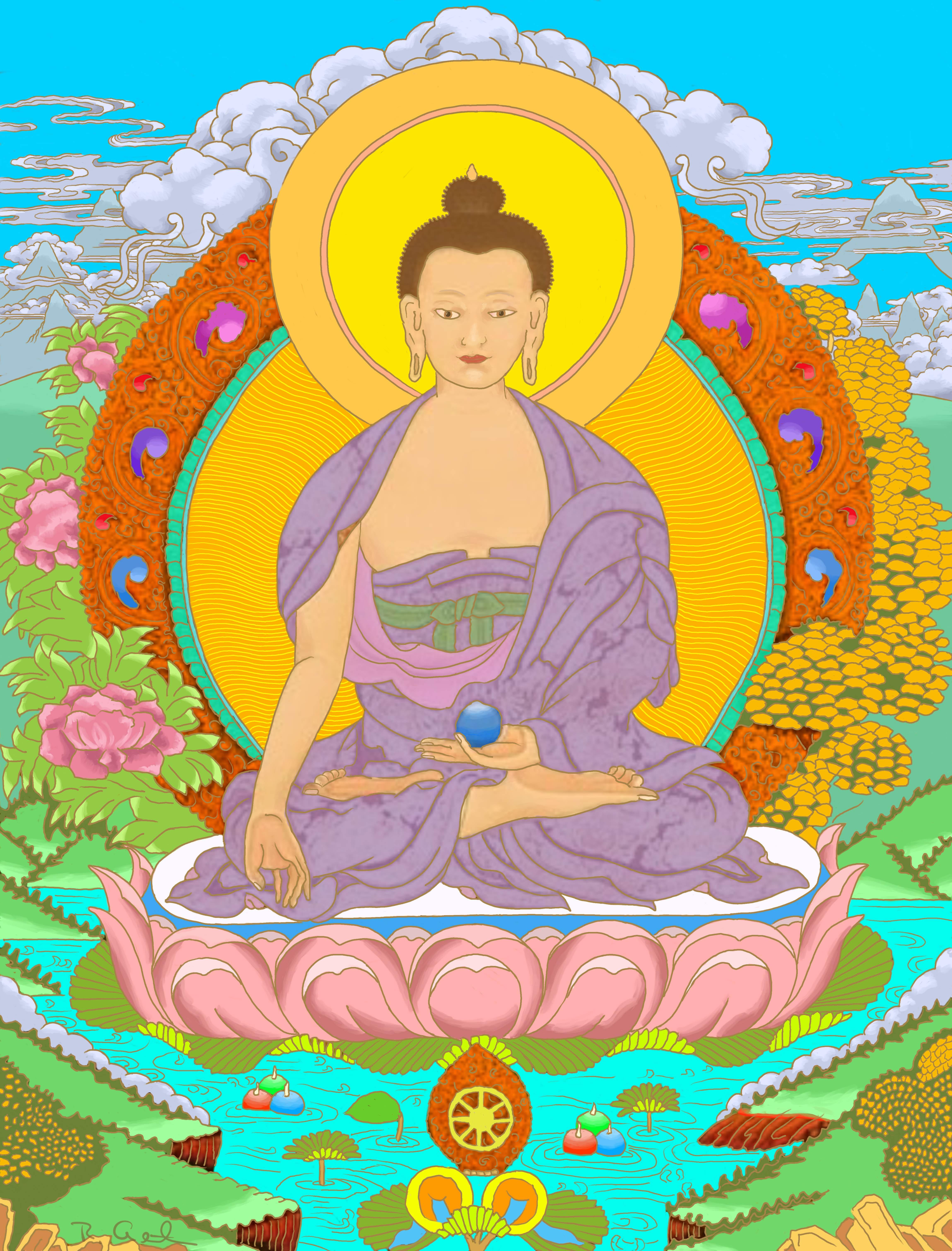
Ratnasambhava: The Ratna Family
The Ratna Family is characterized by a rich, earthy quality that is proud in the best sense: generous, compassionate, and nurturing, almost motherly in its supportiveness. It is full of confidence, often resourceful, and drawn to outer forms such as business, money or fundraising. It is comfortable being the center of attention.
In its closed form, Ratna energy becomes claustrophobic. Trungpa Rinpoche described it as sickly-sweet honey pouring over everything. Its confidence curdles into an arrogant I can do it all by myself. Ratna people tend to get physically large; they are often athletic, and they react to the spaciousness with fear of their own insubstantiality, defending against it by eating more, and taking up more room. Its element is earth. Its color is yellow and its direction is south.
The Dhyani Buddha of this family is Ratnasambhava,”the Jewel Born.” His mudra is varada, the gesture of supreme giving, with palm open and turned outward. His symbol is the wish-fulfilling jewel. Ratnasambhava transforms pride into the wisdom of equanimity (samata-jnana), the awareness that recognizes the equal, jewel-like value of all beings and all experiences.
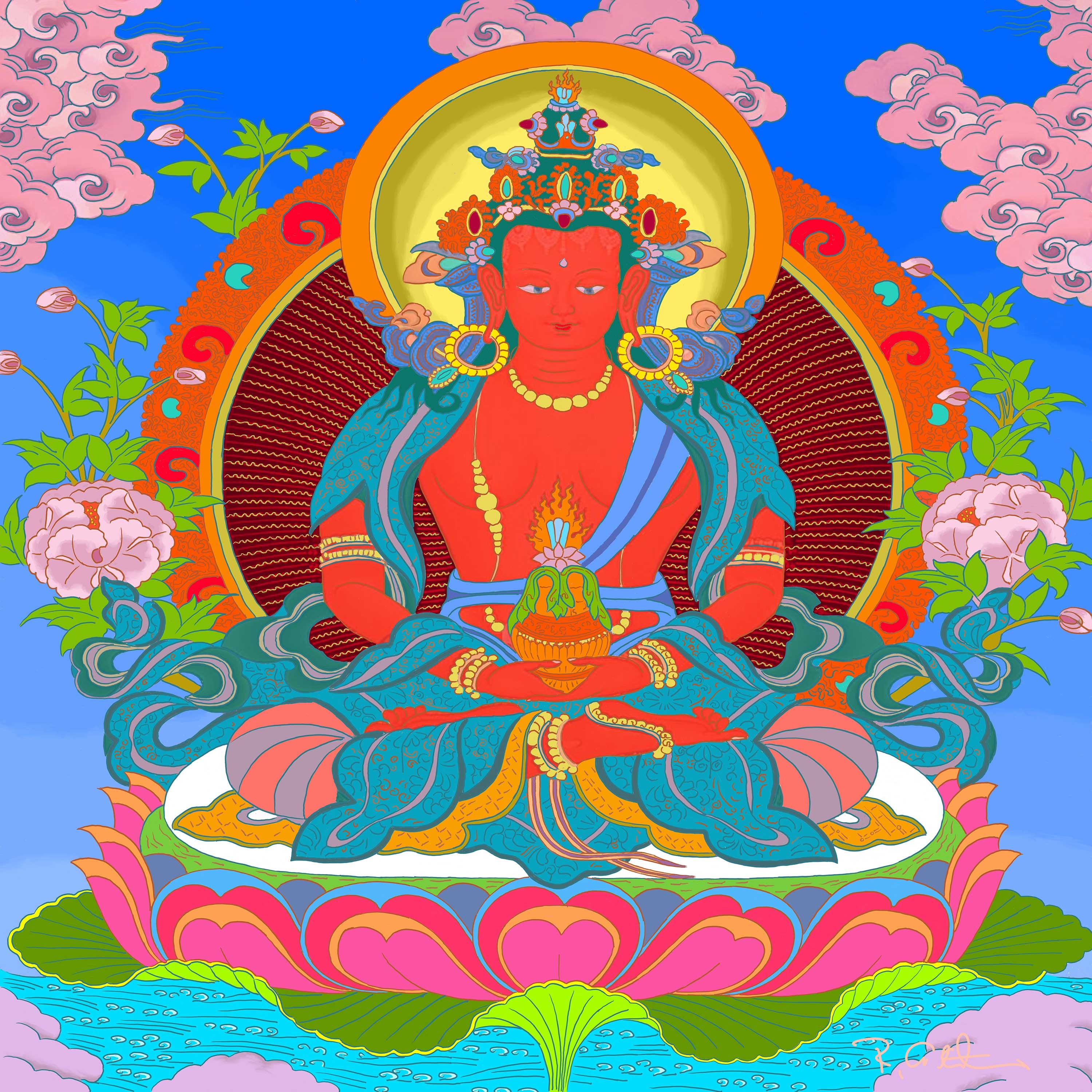
Amitabha: The Padma Family
The Padma Family is characterized by passion that is charismatic and seductive. Padma energy is the life of the party; everyone wants to be close to it. It is a people energy that energizes and integrates the other families, often expressed in outer forms such as the arts. In its negative form, it seduces for the sake of the seduction alone, which causes much suffering. When that negativity is transmuted, it seduces for the sake of communication. Its color is red, its direction is west, and its element is fire.
The Dhyani Buddha of this family is Amitabha, “Infinite Light”, known in Japanese as Amida. He is the most beloved buddha of Pure Land Buddhism. According to the Larger Sukhavativyuha Sutra, when he was still the monk Dharmakara, he made forty-eight great vows; on attaining buddhahood, he established Sukhavati, the western pure land where beings can be reborn and attain liberation. His mudra is dhyana, the meditation gesture, hands resting open in his lap. His symbol is the lotus (padma), the flower that grows in muddy water and opens into immaculate beauty. Amitabha transforms passion into discriminating-awareness wisdom (pratyavekshana-jnana): the precise compassion that sees each being’s unique situation and meets it exactly.
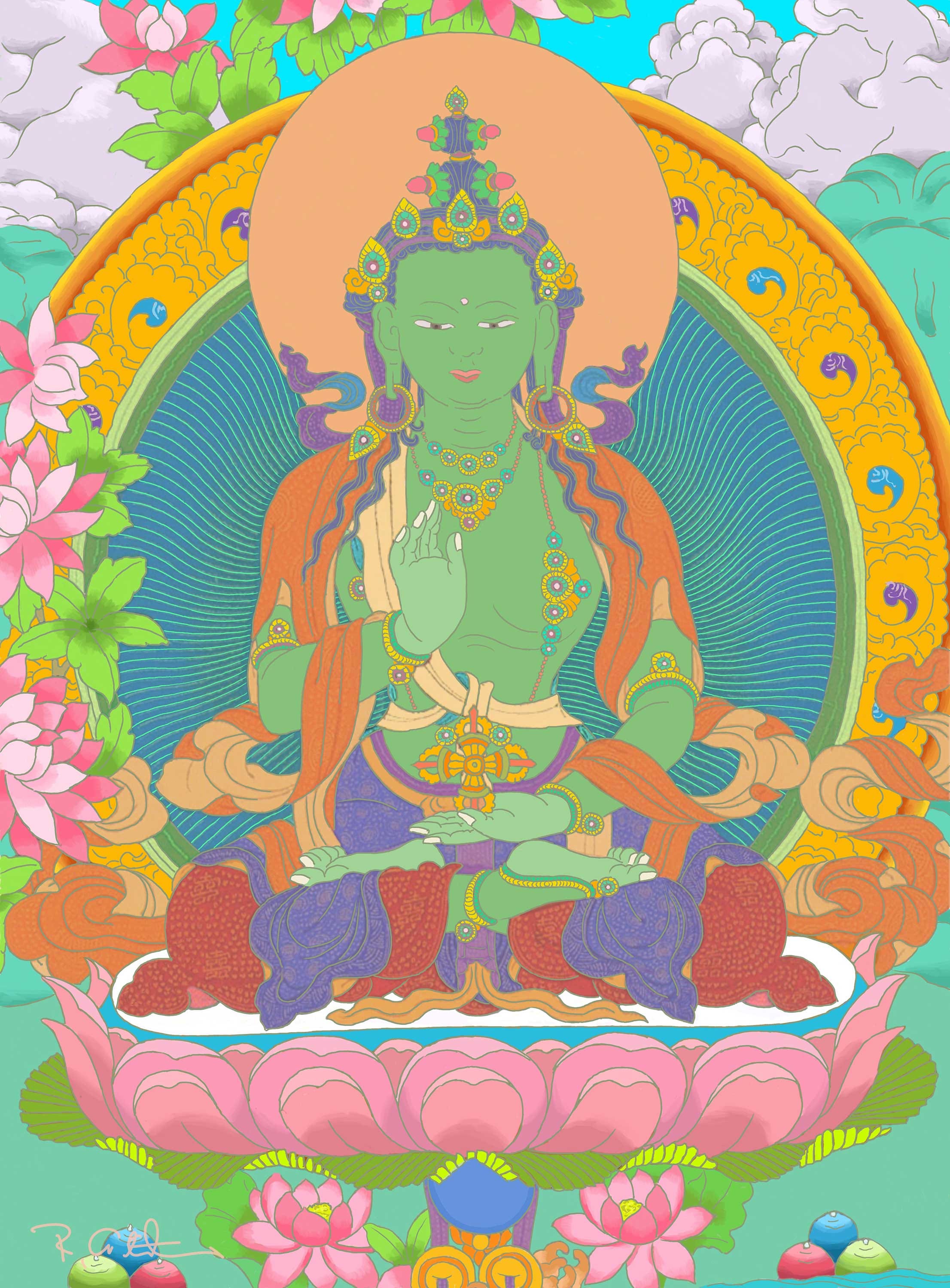
Amoghasiddhi: The Karma Family
Karma Family is a doing energy. It is very efficient and seems to organize without effort. So efficient, in fact, that its end goal is achieved almost automatically. It is a self-fulfilling activity, often expressed in outer forms of social action. But because of this efficiency, it tends to get caught in its own speed. Without peripheral vision, it develops paranoia and jealousy, always comparing and competing. It is aggressive like Vajra but with less intellect and more velocity. Its color is green, its element is wind, and its direction is north
The Dhyani Buddha of this family is Amoghasiddhi, “Unfailing Accomplishment.” His mudra is abhaya, the gesture of fearlessness, with the right hand raised and palm facing outward. His symbol is the vishvavajra, or double vajra; two crossed thunderbolts pointing in all four directions, representing activity that proceeds in every direction without obstruction. Amoghasiddhi transforms jealousy into all-accomplishing wisdom (krityanusthana-jnana): the awareness that knows precisely what activity is needed and carries it out spontaneously, without strain or comparison.
Conclusion
When people first hear about these teachings they naturally wonder which family they belong to. They might treat the framework as a kind of magical astrology or personality system. But it is best to work with these energies without becoming too concrete about them. Though they are represented with many symbols in the mandala, it is best to work with the energies directly without being too intellectual about them. This is an advanced teaching about working with energy directly, and when we try to pin it down in a reductive way, we diminish this profound and rich teaching.
~ Roshi Robert Althouse, © 2026